The model learns process & cycle-time effects from every station above. Propose a station for a new model and it predicts the load — and recommends a plan.模型从上方所有工位学习"工艺 + 节拍"对负荷的影响。为新车型拟一个工位,它会预测负荷并给出工艺规划建议。
ALDA Factory DashboardALDA 智能工厂看板
An AI-embedded body-shop process-capacity monitor I built as a NIO intern — it turns static, messy process spreadsheets into a live view of station load, bottlenecks and overload risk, and learns from past new-model introductions to recommend process plans. This is a sanitized public rebuild on synthetic data.我在蔚来实习期间自建的 AI 嵌入式车身工艺产能监控——把静态、杂乱的工艺表格变成工位负荷、瓶颈与超载风险的实时视图,并从历史新车型导入中学习、给出工艺规划建议。此为脱敏公开重建版,运行在合成数据上。
Try it above — change the factory or process filter, regenerate the dataset, or open the NPI planner: the capacity table, KPIs, the analyst summary and the ML recommendation all update live, entirely in your browser.上方可直接试用——切换工厂/工艺筛选、重新生成数据,或用 NPI 规划器:产能表、KPI、分析摘要与 ML 推荐都会在浏览器里实时更新。
01The problem问题
A car body shop runs hundreds of welding, riveting and gluing stations. Whether each one can hit its target cycle time (CT) decides line throughput — but that judgement was buried in static Excel sheets, updated by hand, exported from different systems with merged cells and inconsistent headers.车身车间有数百个焊接、铆接、涂胶工位。每个工位能否满足目标节拍(CT)决定产线产能——但这一判断被埋在手动维护、来自不同系统、含合并单元格与不统一表头的静态 Excel 里。
There was no live answer to two everyday questions: which stations are overloaded right now, and what will a new model do to line capacity before we commit to it?对两个每天都问的问题,没有实时答案:此刻哪些工位超载?新车型在投产前会对产线产能造成什么影响?
02What I built我做了什么
ALDA is a small pipeline with a dashboard on top. It cleans the data, computes real capacity metrics, learns from history, and explains itself in plain language.ALDA 是一条带看板的小流水线:清洗数据、计算真实产能指标、从历史中学习,并用自然语言解释自己。
- Ingestion & cleaning. Swallows messy spreadsheets — merged cells, Feishu-style dict cells, shifting column names — and normalizes them to a canonical station table.导入与清洗。吞下杂乱表格(合并单元格、飞书式字典单元格、漂移的列名),归一化成规范的工位表。
- Metric engine. Per process type it derives a standard time (BEC) from equipment KPI, then computes available vs occupied time, overload seconds, and a takt load-ratio per station.指标引擎。按工艺类型从设备 KPI 推出标准工时(BEC),再算可用 vs 占用时间、超载秒数与每工位节拍负荷率。
- ML / NPI planner. A model trained on every existing station learns how process type and cycle time drive load, then predicts the load, overload probability and a process-planning recommendation for a proposed new-model station.ML / NPI 规划器。在所有现有工位上训练的模型,学习工艺类型与节拍如何决定负荷,再为拟建的新车型工位预测负荷、超载概率与工艺规划建议。
- Analyst layer. An offline, rule-based 'AI 智脑' ranks the worst bottlenecks and suggests fixes with no API key; the internal version also calls an LLM for free-text Q&A.分析层。离线规则式「AI 智脑」无需 API key 即可排出最严重瓶颈并给建议;内部版另接 LLM 做自由问答。
03How the metrics work指标怎么算
For each station, occupied time sums material-handling, equipment- and fixture-service time and the process time (BEC). The load-ratio is occupied ÷ available time; anything above 1.0 cannot keep up with the line and is flagged as overloaded. The bars above are sorted by that ratio, with the capacity line drawn at 1.0.每个工位的占用时间 = 搬运 + 设备服务 + 工装服务 + 工艺工时(BEC)之和。负荷率 = 占用 ÷ 可用时间;大于 1.0 即跟不上产线节拍,标为超载。上方的条按该比率排序,产能线画在 1.0。
04The ML recommendationML 推荐
New-model introduction (NPI) is where capacity planning gets risky — you commit tooling and floor space before the line exists. ALDA fits a regression across the historical stations (process type + cycle time → load) and uses it to predict where a proposed station will land relative to capacity, with an overload probability and a concrete plan: split the process, add a parallel unit, relax the cycle time, or re-balance takt.新车型导入(NPI)是产能规划最危险的环节——要在产线还不存在时就投入工装与场地。ALDA 在历史工位上拟合回归(工艺类型 + 节拍 → 负荷),据此预测拟建工位相对产能的位置,给出超载概率与具体方案:工艺拆分、增设并行设备、放宽节拍或重新平衡。
05Result结果
Engineers got a one-glance capacity board: filter to a line, instantly see overloaded stations ranked by severity, read a plain-language bottleneck summary, and stress-test a new model before committing. Alongside the dashboard I also supported eBOP optimization with PDPS and F2 final-assembly / body-line layout integration.工程师有了一眼看懂的产能看板:筛到某条线,立刻看到按严重度排序的超载工位,读到自然语言瓶颈摘要,并在投产前对新车型做压力测试。除看板外,我还用 PDPS 支持 eBOP 优化与 F2 总装/车身产线 Layout 合图。
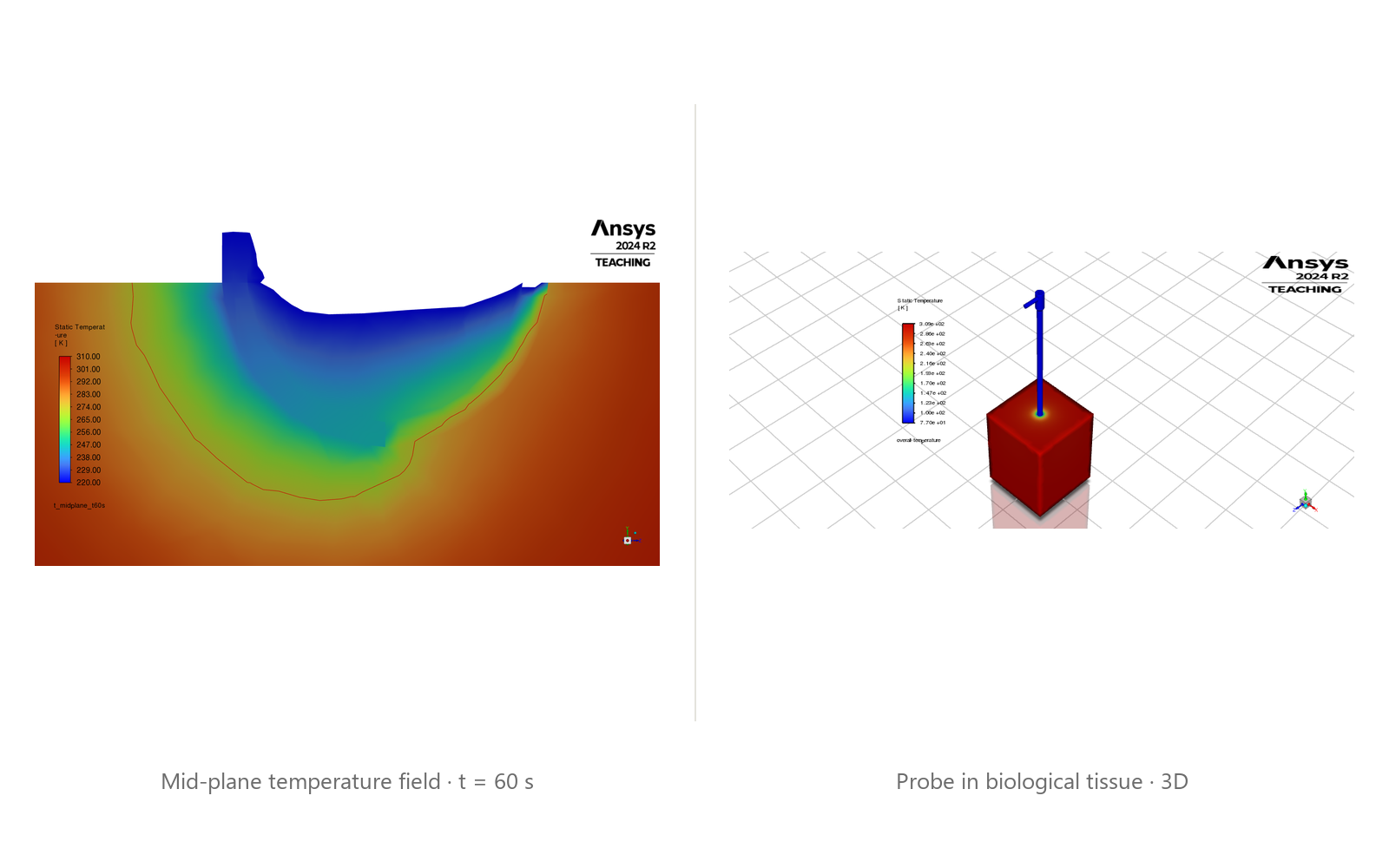
Cryoprobe CFD冷冻消融探针 CFD
A full 3D conjugate-heat-transfer CFD model of a 3-concentric-tube liquid-nitrogen cryoprobe freezing an agar tissue phantom, in ANSYS Fluent 2024 R2.液氮 3 同心管冷冻探针在琼脂组织体模中冻结的全 3D 共轭传热 CFD 模型(ANSYS Fluent 2024 R2)。